
How to Remove Uneaten Fish Food From an Aquarium

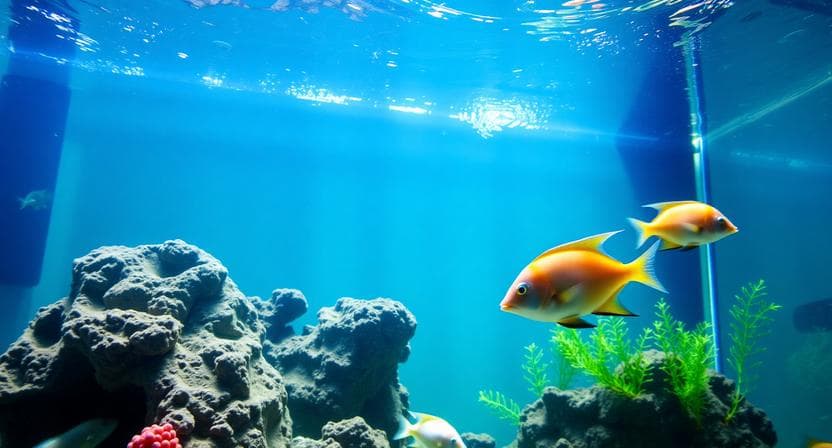
To remove uneaten fish food from an aquarium, the fastest and safest method is manual removal.
You can remove uneaten fish food using a turkey baster, fine mesh net, or gravel vacuum right after feeding, before it settles and decomposes, which protects water quality and prevents ammonia spikes.
Most fish owners eventually run into this problem, whether from a slightly generous scoop of flakes or a pinch of pellets that drifted into a spot the fish never found. Uneaten food doesn't just disappear on its own.
It sinks, gets trapped in gravel, and begins breaking down almost immediately, releasing compounds that quietly work against everything you're trying to achieve with a clean, stable tank.
This guide walks you through exactly how to remove uneaten fish food using tools you likely already own or can pick up cheaply, along with substrate-specific techniques, cleanup crew options, and the feeding habits that prevent the problem from recurring in the first place.
You'll also find a breakdown of common mistakes that tend to make the issue worse rather than better.
By the time you finish reading, you'll have a clear, repeatable routine for handling leftover food, whether you're dealing with a heavily planted tank, a bare bottom setup, or a thick bed of sand that seems to swallow every stray pellet that drifts near it.
Why Uneaten Fish Food Is a Problem in Your Tank
Uneaten food might seem harmless sitting at the bottom of the tank, but it starts decomposing almost as soon as it settles.
As it breaks down, it releases ammonia, one of the most toxic compounds your fish can be exposed to, even in relatively small concentrations. This is the core reason aquarists treat leftover food as more than just a cosmetic annoyance.
The decomposition process also feeds unwanted bacteria and fungal growth, which can cloud the water and create a film across the substrate that's both unsightly and unhealthy.
In tanks with poor filtration or infrequent maintenance, this buildup compounds quickly, turning what started as a few stray flakes into a genuine water quality issue within just a few days.
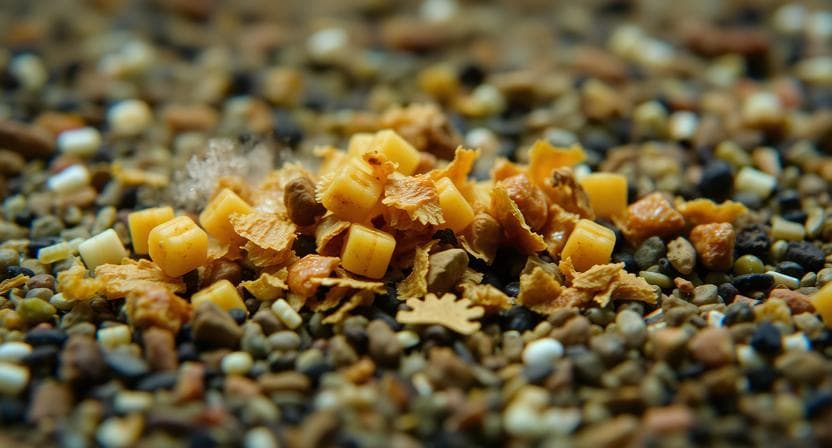
Beyond ammonia, decaying food consumes oxygen as it breaks down, competing directly with your fish for a resource they can't do without.
In smaller or heavily stocked tanks, this oxygen drain can be significant enough to stress fish, particularly overnight when photosynthesis from live plants isn't adding oxygen back into the water.
It's worth noting that the risk scales with tank size and stocking density. A large, lightly stocked aquarium can usually absorb an occasional feeding mistake without major consequences, but a small, densely populated tank has far less room for error, which is exactly why learning to remove uneaten fish food promptly matters so much.
How Leftover Food Affects Water Quality
Ammonia produced by decomposing food doesn't stay isolated to one corner of the tank. It disperses through the water column, gradually raising overall ammonia levels even if the fish never directly touch the rotting food itself.
This is part of why regular water testing remains such a valuable habit, even in tanks that appear visually clean.
As ammonia rises, your biological filter works overtime trying to convert it into less harmful compounds through the nitrogen cycle.
A well-established filter can usually keep pace with occasional leftover food, but repeated overfeeding can overwhelm even a mature filtration system, leading to a genuine ammonia spike that puts real stress on your fish.
Cloudiness is often the first visible symptom of a water quality problem tied to leftover food. If you've noticed your water turning hazy within a day or two of feeding, decomposing food debris sitting in the gravel or on the substrate is one of the most common culprits behind that change.
Signs You're Overfeeding Your Fish
Persistent leftover food after every feeding session is one of the clearest signs that you're offering more than your fish can realistically consume in the two to three minutes typically recommended for a feeding window.
If food is still visibly present well after that window closes, it's worth scaling back the portion size.
Cloudy water that reappears shortly after each water change often points back to feeding habits rather than filtration problems.
If your water clears up nicely after a change but clouds again within a day or two, take a closer look at how much food is going in and how quickly your fish are clearing their plates, so to speak.
Excess waste and unusually rapid algae growth can also indicate overfeeding, since uneaten food and increased fish waste both contribute nutrients that fuel algae blooms.
If you're fighting a persistent algae problem despite reasonable lighting and maintenance, your feeding routine deserves a second look.
Health Risks for Fish and the Ecosystem
Elevated ammonia from decomposing food causes real physical harm to fish, including gill damage, lethargy, and increased susceptibility to disease.
In severe cases, ammonia poisoning can be fatal, which is why prompt cleanup after feeding isn't just about aesthetics.
The tank's broader ecosystem, including beneficial bacteria colonies, plants, and any invertebrates you're keeping, also suffers under poor water conditions driven by decomposing food.
Beneficial bacteria populations can become imbalanced when nutrient levels spike unpredictably, occasionally leading to bacterial blooms that further cloud the water.
Long-term exposure to elevated ammonia and nitrite, even at sublethal levels, has been associated with chronic stress in fish, weakened immune response, and reduced lifespan.
These effects often develop gradually, which makes consistent food removal and feeding discipline a more important long-term health factor than many aquarists initially realize.
How to Remove Uneaten Fish Food
The most direct way to remove uneaten fish food is to physically extract it from the water shortly after feeding, before it has a chance to settle deep into the substrate or begin decomposing.
A turkey baster works well for open water columns and smooth surfaces, letting you gently suck up floating or slightly sunken debris without disturbing the rest of the tank.
For food that has already settled into gravel, a gravel vacuum offers a more thorough solution, pulling debris up from between the stones while simultaneously performing a partial water change.
This dual-purpose function makes gravel vacuuming one of the most efficient tools available for anyone serious about consistent tank maintenance.
Timing plays a significant role in how effective your cleanup efforts are.
Removing leftover food within fifteen to thirty minutes after feeding dramatically reduces the amount of decomposition that occurs, compared to waiting until the next day or the next scheduled cleaning session.
If you're dealing with a particularly messy feeding, such as after using frozen or gel foods that tend to break apart, a fine mesh net skimmed gently across the surface and through the water column can catch fragments before they sink at all, reducing the cleanup burden on your substrate later.
Tools and Equipment for Removing Leftover Food
Having the right tools on hand makes the process of removing uneaten fish food faster and far less disruptive to your tank's overall balance.
Most of these tools are inexpensive, widely available, and worth keeping within easy reach near your tank rather than tucked away in storage.
Choosing the right tool often depends on the type of substrate you're working with and the specific type of food you feed.
Flakes, pellets, frozen food, and gel food all behave differently in water, sinking, floating, or dissolving at different rates, which affects which removal method works best in each situation.
Below is a quick comparison of the most commonly used tools for this task:
| Tool | Best For | Notes |
|---|---|---|
| Turkey baster | Open water, smooth surfaces | Gentle, precise, low disturbance |
| Fine mesh net | Floating or surface debris | Quick, ideal right after feeding |
| Gravel vacuum | Gravel substrates | Doubles as a partial water change |
| Pipette | Small tanks, precise spots | Great for nano tanks and corners |
Investing in even one or two of these tools can dramatically simplify your regular maintenance routine, especially if you feed multiple times per day or keep a tank with fish that tend to leave food behind more often than others.
Gravel Vacuums and Siphons
A gravel vacuum works by creating suction that pulls water, along with any debris sitting in or near the substrate, up through a wide tube while gravel itself is generally too heavy to be pulled along with it.
This makes it one of the most effective tools for removing uneaten fish food that has already settled deep into a gravel bed.
Using a gravel vacuum typically involves inserting the tube directly into the substrate and moving it slowly across sections of the tank floor, allowing the suction to lift trapped debris without uprooting plants or disturbing decor excessively.
Most aquarists combine this process with their regular partial water changes for maximum efficiency.
Siphon-style vacuums range from simple manual versions, which rely on you starting the flow by hand, to battery-powered versions that start suction automatically.
Either style works well, though battery-powered models tend to offer more consistent control for beginners who haven't quite mastered the manual siphoning technique yet.
Fine Mesh Nets
Fine mesh nets excel at catching food before it sinks, making them particularly useful immediately after a feeding session.
Their tight weave prevents small flake fragments or pellet crumbs from slipping through, unlike standard fish nets designed primarily for catching fish rather than fine debris.
Skimming the surface gently with a fine mesh net right after feeding, especially with flake food that tends to float briefly before sinking, can capture a significant portion of leftover food before it ever reaches the substrate. This proactive step reduces the overall cleanup burden later.
Fine mesh nets also work well for spot-cleaning specific areas where food tends to accumulate, such as corners with slower water flow or spots behind decorations where a gravel vacuum might be harder to maneuver effectively.
Turkey Basters and Pipettes
A turkey baster offers precise, targeted removal of uneaten food without disturbing the surrounding water or substrate significantly.
By gently squeezing and releasing the bulb near a cluster of leftover food, you can suck up debris and dispose of it quickly, making this one of the gentlest removal methods available.
Pipettes function similarly but on a smaller scale, making them especially useful in nano tanks or for precise spot-cleaning in planted aquariums where you want to avoid disturbing delicate plant roots or substrate layers. Their narrow tip allows access to tight spaces a baster might struggle to reach.
Both tools share the advantage of being reusable, inexpensive, and gentle enough to use frequently without risking harm to fish, plants, or beneficial bacteria colonies living in and around the substrate.
Step-by-Step Guide to Cleaning Up Fish Food Debris
Cleaning up leftover food effectively starts with observation. Spend a minute or two after each feeding watching where uneaten food tends to settle, since this pattern often repeats across feedings and helps you target cleanup efforts more efficiently going forward.
Once you've identified problem areas, use the appropriate tool, whether that's a net for floating debris, a baster for isolated clusters, or a gravel vacuum for anything that has already settled into the substrate.
Removing food promptly, ideally within the first thirty minutes after feeding, minimizes decomposition and the associated water quality risks.
Follow this general sequence for the most efficient results:
- Observe the tank for two to three minutes after feeding to identify uneaten portions
- Skim the surface with a fine mesh net for floating debris
- Use a turkey baster or pipette for isolated clusters near decor or corners
- Run a gravel vacuum over heavily affected substrate areas
- Check water parameters periodically to confirm ammonia and nitrite remain stable
Consistency matters more than perfection in this process. Even a quick, five-minute cleanup routine performed regularly after feedings will keep your water quality significantly more stable than sporadic, thorough cleanings performed only once every week or two.
Removing Uneaten Food From Different Substrates
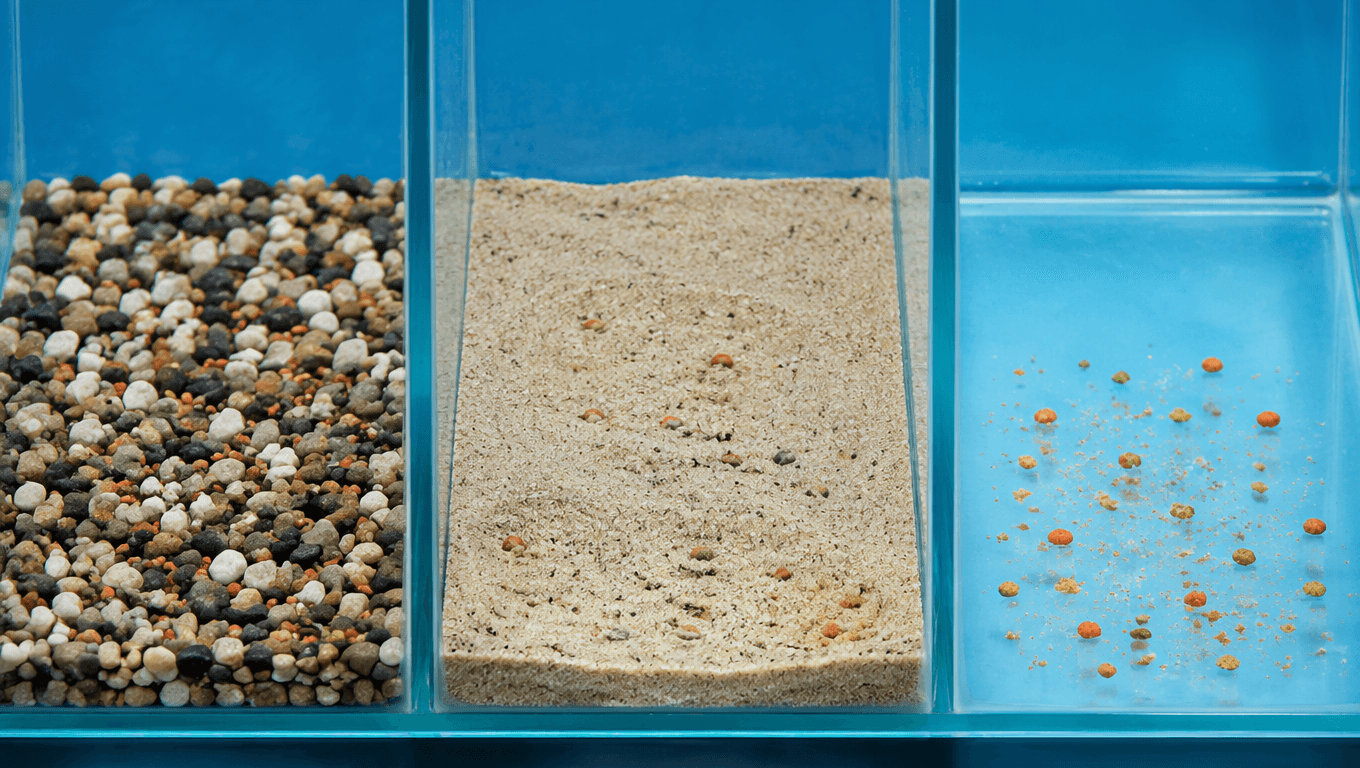
Your substrate type plays a major role in how uneaten food behaves and how easily you can remove it. Gravel, sand, and bare bottom setups each present distinct challenges, and adapting your removal technique to your specific substrate makes the entire process considerably more efficient.
Understanding these differences also helps you anticipate problem areas before they become significant.
A substrate that traps food easily requires more frequent, targeted cleanup, while a bare bottom tank might only need occasional attention since debris remains fully visible and accessible at all times.
Gravel Substrates
Gravel offers plenty of small gaps where uneaten food can settle and become difficult to spot without close inspection.
A gravel vacuum remains the most effective tool here, since its suction reaches into these gaps in ways that surface skimming simply can't replicate.
Regular vacuuming, ideally every one to two weeks depending on your feeding habits and stocking density, prevents food debris from accumulating to problematic levels within the gravel bed.
Heavily stocked tanks or those with larger, messier eaters may benefit from more frequent vacuuming sessions.
Larger gravel tends to trap less food than finer gravel, simply due to the size of the gaps between individual stones.
If you're setting up a new tank and know you'll be dealing with messy eaters, choosing a slightly coarser gravel can make ongoing maintenance noticeably easier.
Sand Substrates
Sand substrates behave differently from gravel, often trapping food at or near the surface rather than allowing it to sink deep between particles. This makes surface-level cleaning tools, such as turkey basters or specialized sand-safe vacuum attachments, particularly effective for sand-based tanks.
Standard gravel vacuums can be too aggressive for sand, potentially pulling large amounts of substrate along with the debris you're trying to remove.
Many aquarists use a gentler technique, hovering the vacuum tip just above the sand surface rather than pushing it directly into the substrate, to avoid disrupting the sand bed excessively.
Sand-dwelling cleanup crew members, discussed further in the next section, can be particularly helpful in sand substrates, since certain species naturally sift through sand in search of food, helping keep the surface layer cleaner between your own manual maintenance sessions.
Bare Bottom Tanks
Bare bottom tanks, often used in breeding or quarantine setups, make uneaten food immediately visible and generally the easiest substrate type to clean thoroughly. Without gravel or sand to trap debris, a simple siphon or even a careful scoop with a net typically handles cleanup with minimal effort.
The visibility advantage of bare bottom tanks also makes it easier to fine-tune feeding portions over time, since you can directly observe exactly how much food goes uneaten after each session and adjust accordingly without guesswork.
Despite the easier cleanup, bare bottom tanks still benefit from prompt food removal, since decomposition begins just as quickly regardless of what's sitting beneath the debris.
The main advantage here is speed and simplicity of the cleanup process itself, not a reduced need for it.
Using a Cleanup Crew to Manage Leftover Food
An aquarium cleanup crew, typically composed of bottom-dwelling fish, snails, or shrimp, can help manage small amounts of leftover food between your regular manual cleaning sessions. While a cleanup crew shouldn't replace deliberate removal efforts entirely, it can meaningfully reduce the overall debris load in a tank.
Popular cleanup crew choices include Corydoras catfish, certain loach species, nerite snails, and various shrimp species, each of which forages through substrate and consumes small food particles that might otherwise be missed during manual cleaning. Their natural foraging behavior complements rather than replaces your own maintenance routine.
It's important not to rely on a cleanup crew as your sole method of debris management. These species require their own food sources beyond leftover scraps to stay healthy, and expecting them to survive purely on uneaten food from other fish can lead to malnutrition over time, defeating the purpose of adding them in the first place.
A well-balanced approach combines a modest cleanup crew with consistent manual removal and disciplined feeding habits.
This combination tends to produce noticeably cleaner substrate and more stable water parameters than relying on any single method in isolation.
How to Prevent Uneaten Food in the First Place
Preventing uneaten food from becoming a recurring issue starts with adjusting portion sizes to match what your fish can realistically consume within a short feeding window, typically two to three minutes for most community fish. Overestimating appetite is one of the most common feeding mistakes new aquarists make.
Observing your fish closely during feeding helps you calibrate portions more accurately over time.
If food consistently remains after each feeding, reduce the amount slightly at the next session and continue adjusting until you find the sweet spot where fish finish their portion with little to nothing left behind.
Feeding smaller amounts more frequently, rather than one large feeding per day, can also reduce leftover food significantly, since smaller portions are easier for fish to consume completely and leave less room for excess to settle into the substrate.
Consider keeping a simple feeding log for the first week or two after adjusting your routine. Tracking how much food you offer against how much remains uneaten gives you concrete data to refine your approach, rather than relying purely on guesswork or memory.
Feeding the Right Amount
A commonly cited guideline suggests offering only as much food as your fish can consume within two to three minutes, though this can vary somewhat depending on species, tank size, and the number of fish present.
Starting with a smaller portion and adjusting upward if needed tends to work better than starting too generously.
Smaller fish and juvenile specimens generally require less food per feeding than larger, more established fish, so tanks with mixed age groups or species may need slightly more nuanced portion calculations to avoid consistently overfeeding certain individuals while underfeeding others.
If you're ever uncertain, erring on the side of slightly underfeeding is generally safer than overfeeding. Most healthy adult fish can comfortably go a day or two without food if needed, while consistent overfeeding creates the ongoing water quality issues this article has focused on throughout.
Choosing the Right Food Type
Different food types sink, float, or dissolve at different rates, which affects how much ends up uneaten and how quickly it needs to be removed.
Flakes tend to break apart and disperse more than pellets, sometimes making complete consumption slightly harder for fish to track down before pieces scatter.
Sinking pellets designed for bottom feeders can help ensure food reaches species that don't compete well at the surface, reducing the amount of food that goes unnoticed and eventually uneaten simply because it never reached the intended fish in the first place.
Matching food type to your specific fish species and their natural feeding behavior, whether that's surface feeding, mid-water feeding, or bottom feeding, generally results in more complete consumption and less leftover debris compared to a generic, one-size-fits-all feeding approach.
Establishing a Consistent Feeding Schedule
Fish adapt well to predictable feeding schedules, often becoming more actively engaged and ready to eat at consistent times each day.
This heightened readiness tends to reduce the amount of food left uneaten, since fish are more likely to consume their portion promptly rather than gradually picking at it over time.
Irregular feeding schedules, by contrast, can lead to inconsistent appetite and behavior, sometimes resulting in fish that eat less enthusiastically or miss food entirely because they weren't actively anticipating a feeding at that particular moment.
A simple, consistent schedule, such as feeding twice daily at roughly the same times each day, tends to produce more predictable consumption patterns and, as a result, noticeably less leftover food requiring cleanup afterward.
Maintaining Water Quality After Feeding
Water quality maintenance after feeding extends beyond simply removing visible debris. Regular water testing helps you confirm that ammonia, nitrite, and nitrate levels remain within safe ranges, even when your cleanup efforts appear thorough on the surface.
Partial water changes, typically ten to twenty percent performed weekly or biweekly depending on your tank's specific needs, help dilute any accumulated waste products that manual debris removal alone might not fully address.
Combining water changes with regular gravel vacuuming tends to produce the most stable long-term results.
A healthy, well-established filtration system also plays a significant role in managing the aftermath of occasional leftover food.
Beneficial bacteria colonies housed in your filter media continuously break down ammonia and nitrite into less harmful compounds, providing an important buffer against the occasional feeding mistake.
Monitoring your fish's behavior after feeding offers another useful indicator of overall water quality.
Fish that appear lethargic, gasp at the surface, or show reduced appetite shortly after feeding sessions may be signaling a water quality issue worth investigating further, even if visible debris has already been removed.
Common Mistakes When Cleaning Uneaten Fish Food
One frequent mistake involves waiting too long after feeding to begin cleanup, allowing food to decompose significantly before any removal effort begins.
Even a delay of just a few hours can meaningfully increase ammonia production compared to prompt removal within the first thirty minutes.
Using tools too aggressively, particularly gravel vacuums in sand substrates, is another common error that can disturb the tank more than necessary, uprooting plants or creating unwanted cloudiness that takes time to settle.
Matching your tool and technique to your specific substrate helps avoid this issue.
Relying too heavily on a cleanup crew without adjusting feeding habits is a mistake that tends to mask the underlying problem rather than solving it.
While a cleanup crew helps manage minor debris, it shouldn't be treated as a substitute for accurate portion control and prompt manual removal.
Finally, neglecting to test water parameters after a particularly messy feeding session means you might miss early signs of an ammonia spike until symptoms become visible in your fish. Regular testing, especially after any feeding mishap, remains one of the simplest ways to catch problems before they escalate.
Getting comfortable with removing uneaten fish food quickly becomes second nature once it's built into your regular routine, and the payoff shows up clearly in clearer water, healthier fish, and noticeably less time spent battling algae or cloudy tanks down the line.
Small, consistent habits here tend to matter far more than occasional deep cleans.
If you've found a particular tool or technique that works especially well for your own tank, share it in the comments below so other aquarists dealing with the same messy feeding sessions can benefit from what's worked for you.
And if this guide helped clear up your questions, pass it along to a fellow fishkeeper who might be scooping out soggy flakes right about now.