
What to Do When Your Aquarium Water Turns Green

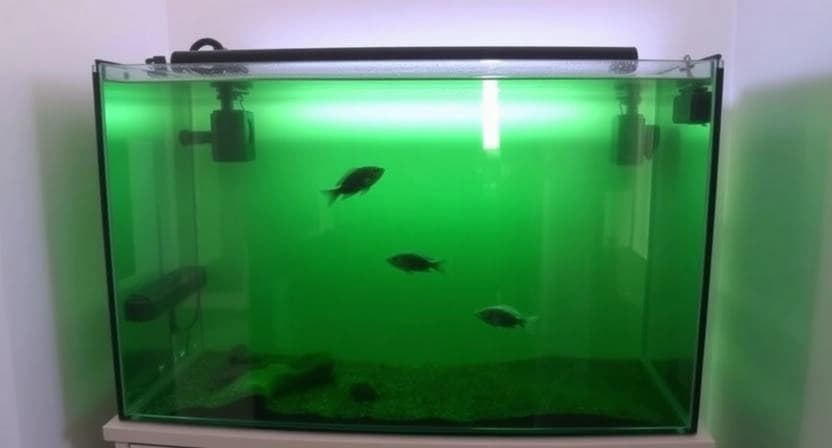
What to do when your aquarium water turns green is a common concern among fish keepers, and the solution involves controlling light exposure, managing nutrient levels, and maintaining proper filtration.
Green aquarium water is typically caused by an algae bloom, specifically free-floating algae that multiply rapidly when conditions favor their growth.
This phenomenon can occur in both new and established tanks, often catching aquarium owners by surprise.
While green water might look alarming, it rarely poses an immediate threat to fish health. Understanding the underlying causes helps you address the problem effectively and prevent future occurrences.
This guide walks you through practical steps to restore crystal-clear water and maintain a balanced aquatic environment.
You'll learn how to identify the type of green water issue you're facing and implement proven solutions. From adjusting lighting schedules to optimizing filtration, these strategies work together to eliminate algae blooms and keep your aquarium looking its best.
Understanding Why Green Aquarium Water Occurs
Green aquarium water develops when microscopic algae cells suspended in the water column reproduce rapidly. These tiny organisms thrive in conditions that provide them with everything they need to multiply.
When your tank water takes on a greenish tint, you're witnessing a population explosion of these single-celled algae.
The transformation from clear to green water doesn't happen overnight. Initially, you might notice a slight cloudiness or subtle color change.

As algae cells continue dividing, the water becomes progressively more opaque and green. This process can accelerate dramatically under the right conditions, turning a mildly cloudy tank into pea soup within days.
Several environmental factors must align for algae to bloom so intensely. Understanding these factors helps you target the root cause rather than just treating symptoms.
The primary drivers include nutrient availability, light intensity and duration, and water chemistry balance.
Your aquarium is essentially a closed ecosystem where everything you add accumulates over time. Fish waste, uneaten food, decaying plant matter, and tap water minerals all contribute to the nutrient pool that algae can exploit.
When these nutrients reach certain levels, combined with adequate lighting, algae growth becomes inevitable.
The Role of Algae in Aquatic Ecosystems
Algae plays a natural and beneficial role in healthy aquatic environments. In balanced systems, algae contributes to oxygen production through photosynthesis and serves as a food source for various organisms.
Some algae growth in your tank is normal and even indicates a functioning biological system.
The problem arises when algae populations grow unchecked and dominate the ecosystem. Free-floating algae responsible for green water compete with aquatic plants for nutrients and light.
They can also interfere with your ability to observe and enjoy your fish, which defeats the purpose of having a display aquarium.
Different algae types respond to different environmental triggers. Green water algae differs from the filamentous algae that grows on surfaces or the black beard algae that clings to decorations. Recognizing this distinction helps you apply the most effective treatment approach.
How Excess Nutrients Fuel Algae Growth
Nitrogen and phosphorus are the primary nutrients that fuel algae blooms in aquariums. These elements enter your tank through multiple pathways and accumulate when not removed through water changes or consumed by plants.
Fish produce ammonia through respiration and waste, which beneficial bacteria convert into nitrate, a form of nitrogen readily available to algae.
Overfeeding your fish creates a surplus of nutrients that settles as debris on the substrate. This organic matter decomposes and releases additional nitrogen and phosphorus into the water column. Even small amounts of excess food can significantly impact nutrient levels over time.
Tap water in many areas contains measurable amounts of nitrates and phosphates. Each water change potentially adds to your tank's nutrient load unless you treat or filter the incoming water. Testing your source water helps you understand whether it contributes to the problem.
Dense fish populations produce more waste than sparsely stocked tanks. The biological filtration system can handle only so much waste before excess nutrients begin accumulating. Matching your fish population to your tank's capacity is essential for long-term stability.
Light Exposure and Algae Bloom in Fish Tank
Light acts as the energy source that drives photosynthesis in algae. When algae cells have access to light for extended periods, they can reproduce more rapidly than in darker conditions. The intensity and duration of lighting directly influence how quickly an algae bloom can develop.
Aquarium lights designed for plant growth emit wavelengths that also benefit algae. While plants typically outcompete algae for resources in well-maintained planted tanks, unplanted or lightly planted aquariums give algae a competitive advantage. The same light that showcases your fish also supports unwanted algae growth.
Natural sunlight streaming through windows introduces variable light that's difficult to control. Sunlight contains the full spectrum of wavelengths that algae use most efficiently. Even a few hours of direct sun exposure can trigger or worsen a green water outbreak.
The relationship between light and nutrients creates a synergistic effect. High nutrient levels alone won't cause severe algae blooms without adequate light, and bright lighting won't trigger blooms in nutrient-poor water. When both factors are present, algae can explode in population almost overnight.
Identifying the Type of Green Water Problem
Proper identification of your green water situation guides your treatment approach. Not all green discoloration stems from the same cause, and different issues require different solutions. Taking time to assess what's happening in your tank saves effort and produces better results.
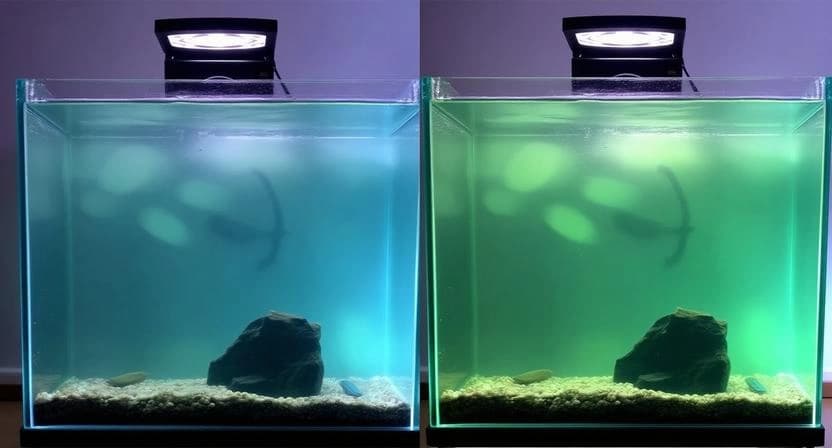
The color intensity provides clues about the severity and type of algae present. Pale green water with good visibility suggests an early-stage bloom or low algae density.
Deep green water where you can barely see through a few inches indicates a well-established bloom requiring immediate attention.
Observing how quickly the discoloration developed offers additional insight. Rapid changes over days suggest a sudden bloom triggered by environmental changes, while gradual greening indicates slowly building nutrient issues.
Your aquarium's history and recent changes to feeding, lighting, or maintenance routines all factor into accurate diagnosis.
Testing water parameters at the same time you assess color helps create a complete picture. Nitrate and phosphate test kits reveal whether excess nutrients are present. This information confirms whether you're dealing with a nutrient-driven algae bloom or another issue entirely.
Free-Floating Algae vs. Surface Algae
Free-floating algae causes water to turn uniformly green throughout the entire water column. These microscopic organisms remain suspended rather than attaching to surfaces.
When you look at your tank from the side, the entire volume appears tinted green, and the water itself has a cloudy appearance.
Surface algae grows on glass, decorations, substrate, and equipment. This type of algae forms visible films, spots, or fuzzy growths that you can see and touch. While surface algae may appear green, it doesn't color the water itself unless pieces break off and float freely.
You might observe both types simultaneously in your aquarium. Surface growth can exist alongside green water, though they often indicate slightly different imbalances. Treating green water doesn't necessarily eliminate surface algae, and vice versa, though improving overall conditions helps with both.
Assessing Water Clarity and Color Intensity
Measuring how far you can see through your aquarium water quantifies the problem's severity. Hold a white card behind the tank or try to see objects at various distances within the water. If you cannot see clearly more than a few inches, you're dealing with a dense algae bloom.
The shade of green varies depending on algae species and concentration. Light green or yellow-green water contains fewer algae cells than dark emerald or blue-green water. These color variations don't necessarily indicate different problems, but they do show progression level.
Taking photos of your tank at regular intervals creates a visual record of changes. Comparing images from different days helps you track whether your treatment efforts are working. This documentation proves especially useful when trying multiple approaches or consulting with experienced aquarists.
Recognizing the Difference Between Cloudy Green Aquarium and Other Discolorations
Green water has a distinct appearance compared to other types of cloudy water. Bacterial blooms create white or grayish cloudiness without the green tint. These bacterial issues often occur in new tanks or after major cleaning that disrupts the biological filter.
Brown or yellow water suggests tannins from driftwood rather than algae. Tannins discolor water but don't create the same opacity as algae blooms. You can typically see through tannin-stained water more easily than through green water of similar color intensity.
Milky white cloudiness that appears after adding substrate or during cleaning results from suspended particles. This type of cloudiness settles relatively quickly as particles either fall to the bottom or get captured by your filter. It doesn't have the persistent, uniform green color of an algae bloom.
Immediate Steps to Address Green Aquarium Water
When you first notice green aquarium water, resist the urge to make drastic changes all at once. Gradual, systematic interventions work better than shocking your tank's ecosystem. Your fish and beneficial bacteria need stability, even while you're correcting environmental issues.
Start by reducing feeding to the absolute minimum your fish need. Feed only what they can consume completely within two to three minutes, once per day.
This immediately cuts nutrient input and reduces the fuel available for algae growth. Your fish can easily handle reduced feeding for several weeks while you address the bloom.
Perform a partial water change of 25 to 30 percent using dechlorinated water. This dilutes both algae cells and excess nutrients in the water column. Avoid changing more than 30 percent at once unless your fish show signs of distress, as large water changes can stress both fish and beneficial bacteria.
Check and clean your filter media without destroying the beneficial bacteria colonies. Rinse mechanical filter media in old tank water to remove debris while preserving bacteria. Replace chemical filtration media if you use activated carbon or other absorptive materials.
Controlling Light to Prevent Algae Overgrowth
Light management stands as one of the most effective tools for combating green water algae. By controlling when and how long your aquarium receives light, you limit the energy available for algae photosynthesis.
This approach works without chemicals and creates no additional stress for your fish.
Many aquarium owners make the mistake of leaving lights on too long, either for viewing enjoyment or because they believe fish need constant illumination.
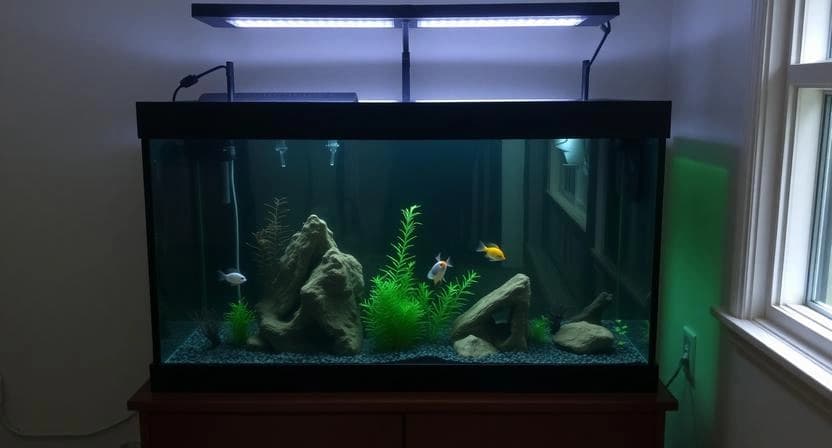
In reality, fish benefit from a regular day-night cycle that mimics natural conditions. Continuous lighting or extended photoperiods disrupt this cycle and favor algae growth.
You can implement a temporary blackout period to knock back severe algae blooms. Covering your tank completely for three to four days eliminates light entirely, which halts algae photosynthesis.
Your fish and beneficial bacteria will survive this darkness without issues, while algae populations crash dramatically.
After a blackout or when maintaining a cleared tank, establishing proper lighting discipline prevents recurrence. Consistency matters more than the specific duration you choose. Creating a stable routine allows your aquarium's ecosystem to find balance.
Optimal Lighting Duration for Your Aquarium
Most aquariums thrive with eight to ten hours of light daily. Planted tanks might need slightly longer photoperiods, while fish-only tanks often do well with eight hours. Experiment within this range to find what works best for your specific setup.
Dividing the photoperiod into two sessions can help planted tanks while still controlling algae. For example, you might run lights for four hours in the morning, off for four hours midday, then four more hours in the evening.
This split schedule, called a siesta period, can limit algae while giving plants adequate light.
Monitor your tank's response to lighting changes over several weeks. If green water persists with eight hours of light, try reducing to six hours. Conversely, if your live plants show signs of struggle, you might need to address nutrient availability rather than further reducing light.
Positioning Your Tank Away from Direct Sunlight
Windows create unpredictable and uncontrollable light exposure that makes algae management nearly impossible. Even indirect sunlight contains sufficient intensity to fuel algae blooms. Positioning your aquarium away from windows gives you complete control over lighting conditions.
If relocation isn't possible, use curtains, blinds, or window film to block natural light during peak hours. Even partial sun exposure can undermine your efforts to control green water through artificial lighting management. The goal is eliminating all uncontrolled light sources.
Consider the seasonal changes in sun angle and intensity when choosing your tank location. A spot that receives no direct sun in winter might get several hours of exposure in summer. Planning for worst-case scenarios ensures year-round algae control.
Using Timers for Consistent Light Management
Digital or mechanical timers eliminate human error and maintain perfect consistency in your lighting schedule. These inexpensive devices ensure your lights turn on and off at exactly the same times every day. Consistency helps your aquarium establish a stable biological rhythm.
Choose a timer with battery backup if you experience occasional power outages. This feature maintains your programmed schedule even after brief electrical interruptions. Some advanced timers allow you to program split photoperiods or gradual ramping of light intensity.
Label your timer settings clearly and document your chosen photoperiod. This makes it easy to maintain the schedule or share information with others who might care for your tank. Keeping records also helps you track what works best over time.
Managing Nutrient Levels for Aquarium Algae Control
Nutrient management requires a multifaceted approach that addresses all sources of nitrogen and phosphorus entering your tank. Simply performing water changes without controlling nutrient inputs only provides temporary relief. You must reduce what goes into the tank while increasing what you remove.
Testing your water regularly for nitrate and phosphate levels provides objective data about your nutrient situation.
Test kits designed for aquarium use give you baseline readings and help you track progress. Aim to keep nitrates below 20 ppm and phosphates as close to zero as possible in fish-only tanks.
Live aquatic plants compete directly with algae for available nutrients. Adding fast-growing stem plants or floating plants creates a biological nutrient export system. Plants absorb nitrogen and phosphorus for growth, effectively starving algae of these essential elements.
Substrate cleaning removes decomposing organic matter before it can release nutrients into the water. Use a gravel vacuum during water changes to siphon debris from between substrate particles. Pay special attention to areas beneath decorations where waste accumulates unnoticed.
Water Change Strategies to Combat Green Water
Regular partial water changes dilute nutrients, remove algae cells, and refresh your aquarium environment.
During a green water outbreak, you might increase water change frequency to twice weekly while reducing feeding. This combination attacks the problem from multiple angles simultaneously.
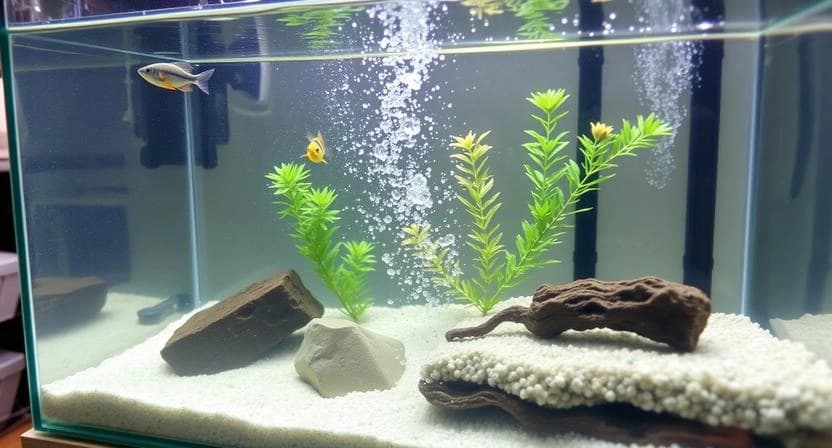
Each water change should replace 25 to 30 percent of total volume for most situations. Larger changes risk shocking fish with parameter swings and can disrupt beneficial bacteria colonies. Small, frequent changes prove more effective than infrequent massive changes.
Always treat tap water with a quality dechlorinator before adding it to your tank. Some municipal water contains chloramines, which require specific neutralization products.
Testing your tap water for ammonia, nitrates, and phosphates tells you whether your source water contributes to the problem.
Temperature-match replacement water to within a few degrees of your tank temperature. Sudden temperature changes stress fish and can trigger disease outbreaks. Fill buckets and let water sit for an hour to reach room temperature, or mix hot and cold water to achieve the target temperature.
Filtration Methods That Help Clear Green Aquarium Water
Mechanical filtration removes suspended algae cells from the water column, though standard filter media may not capture the tiny algae responsible for green water.
Fine filter floss or micron filter pads work better than coarse sponges for trapping microscopic algae. Replace or rinse these fine media frequently as they clog quickly with algae.
UV sterilizers offer a highly effective solution for green water problems. These devices pass water through a chamber where ultraviolet light kills or damages algae cells, preventing reproduction. A properly sized UV sterilizer can clear green water within days without chemicals or drastic measures.
Diatom filters provide ultra-fine mechanical filtration that can clear green water remarkably fast. These specialized filters use diatomaceous earth as a filter medium that traps particles down to one micron. While effective, they require careful maintenance and aren't typically run continuously.
Chemical filtration using phosphate-removing media targets one of algae's key nutrients. Products containing iron-based or aluminum-based compounds bind phosphate and remove it from the water. Use these media cautiously and according to manufacturer directions, as removing too much phosphate too quickly can stress the system.
Preventive Measures to Keep Your Aquarium Water Clear
Long-term prevention requires establishing and maintaining healthy aquarium practices. Consistency in feeding, cleaning, and maintenance prevents the conditions that allow green water to develop. Think of these practices as an integrated system rather than isolated tasks.
Stock your aquarium appropriately for its size and filtration capacity. The common guideline of one inch of fish per gallon provides a rough starting point, though fish bioload varies significantly by species. Research the adult size and waste production of species before adding them to your tank.
Quarantine new fish, plants, and decorations before introducing them to your main tank. This practice prevents introducing excess nutrients, algae spores, or disease. A separate quarantine tank allows you to observe new additions for two to three weeks before transfer.
Feed high-quality foods that fish actually consume rather than cheap fillers that create excess waste. Remove uneaten food within a few minutes using a net or siphon. Observe your fish during feeding to ensure everyone eats and adjust portions accordingly.
Monitor your tank daily for early signs of problems. Catching the first hint of green tint allows you to take corrective action before a full bloom develops.
Brief daily observations become second nature and help you maintain optimal conditions. Regular testing of parameters creates objective data that reveals trends before they become visible problems.
Clean equipment like filters, heaters, and air stones during your regular maintenance schedule. Built-up debris on equipment surfaces contributes to nutrient loads and creates hiding spots for organic matter. Keeping equipment clean improves efficiency and reduces overall tank bioload.
Maintaining crystal-clear aquarium water requires patience, observation, and consistent care rather than complicated equipment or chemical solutions.
When green water does occur, you now have the knowledge to address it systematically while preventing future outbreaks. Your efforts create a healthier environment for your fish and a more enjoyable display for years to come.